2025 Land Management Case Study

You would think that after a decade of intensive work on my land I wouldn’t have had much in the works for 2025 - but you’d be wrong! I had lots of plans, and was able to get a lot done.
I planned to create four hinge-cut barriers, cut or improve six trails, clear shooting lanes at two stands, move a stand, and put up a new stand. I have nine areas where I can improve the bedding cover, though I was lucky to be able to work on just two. My left hip wore out in the summer of 2024 so I scheduled a replacement for the end of April 2025. Just like the previous year, my heavy woods work was delayed until I could recover from surgery so some of the strenuous projects may need to roll into 2026.
There is a spot near the Grove box blind that always collects water so I planned to dig a new pond there. I have solar panels on my barn and the woods to the south have grown-up so I wanted to clear that area. And I had regular maintenance tasks to do, like posting the property lines, put up wind indicator flagging at all stands and blinds, and re-work the camera mounts for wintertime surveillance.
I expected to do the usual soil tests, spraying, cutting, and planting in my food plots. Hopefully, after spreading lime and fertilizer in 2024, there wouldn’t be anything major to do in the fields and plots this year, but you never know. And the epic acorn crop of 2024 shouldn’t repeat itself so soon, so I expected a better hunting season in 2025. Of course, when it comes to land management nothing goes according to plan. Acorns were plentiful on my land for the second year in a row, and it stopped raining in the middle of summer, throwing us into a severe drought.
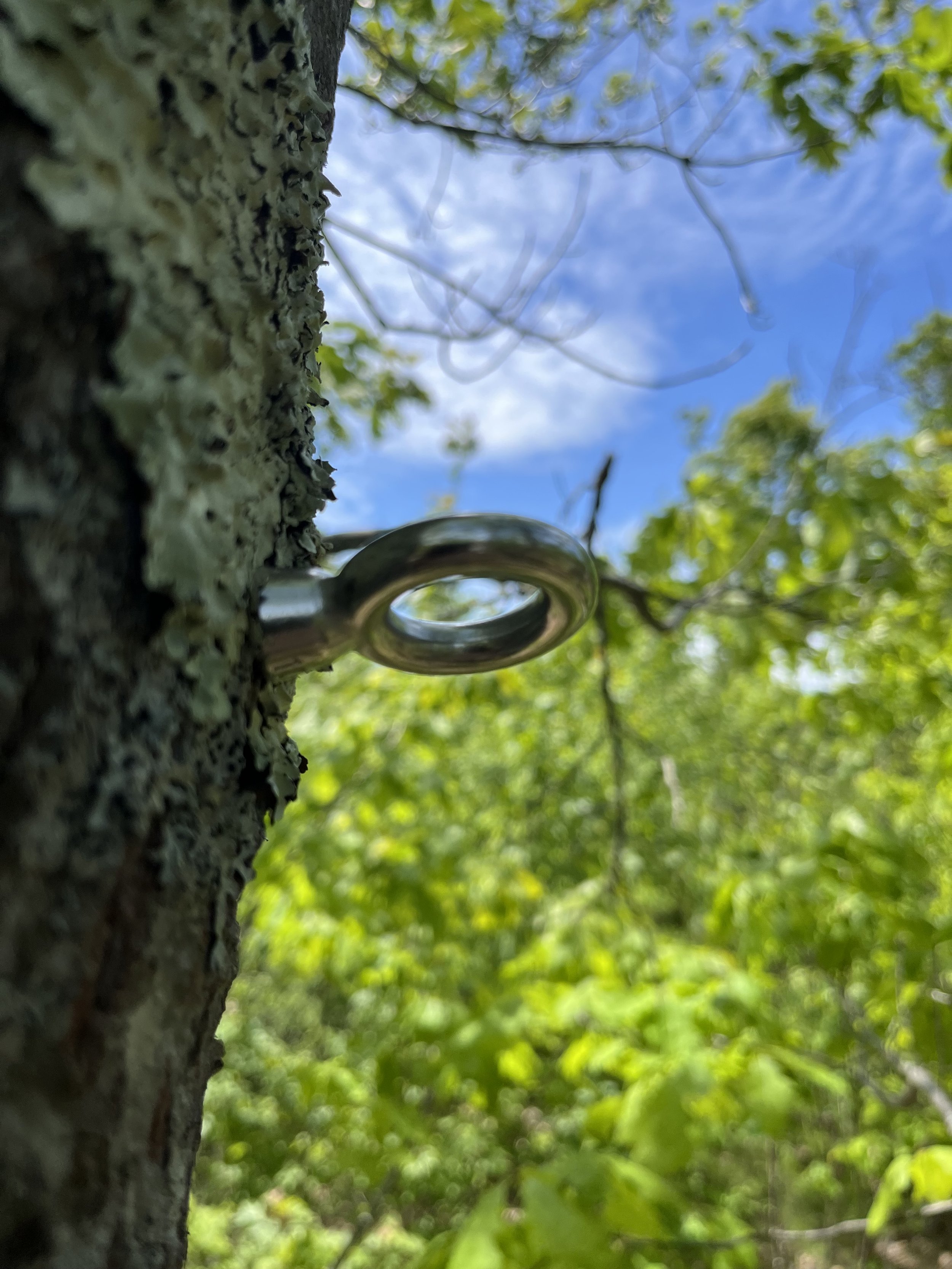
Safety anchor bolt
My goal with this land is to have a fun place to bowhunt, so reducing the regular maintenance is a step in the right direction. One thing I do every year is put up and take down the ropes I use to pull my bow up to a treestand and to clip-in my safety harness. I have about 15 stands so putting up and taking down ropes at the beginning and end of each season is time consuming. Not to mention the risk of climbing that many ladders. And I don’t hunt every stand every year, so much of that effort is wasted. I decided to eliminate the need for the safety ropes by screwing a large stainless steel eyebolt into the trees - a bolt that I could clip into. And I would bring a pull-up rope with me when I hunt so I also wouldn’t have to put that up and take that down. I installed eyebolts in most of my trees and used them during the season.
The winter rye and wheat that I planted in August of 2024 came-up thick in the spring, and the clover was looking lush. I drilled my soybeans into the rye and wheat on June 3rd with good germination, and I came back and crimped at the end of June to lay down a weed-choking thatch. Unfortunately, when August rolled around we were in a drought with no rain in sight.
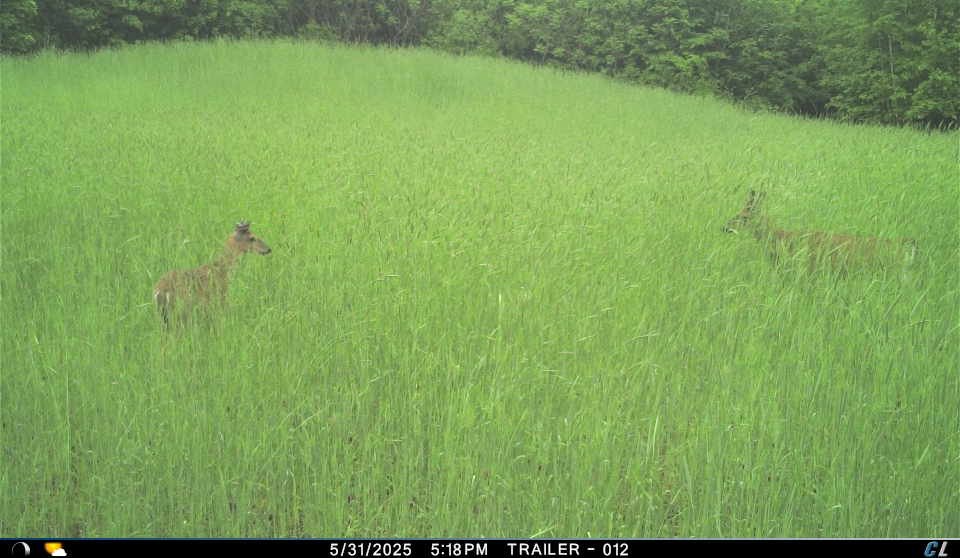
Thick rye and wheat before planting soybeans and crimping
August is when I want to plant my fall blend of brassicas, wheat, and rye - the fall blend keeps growing during the hunting season after the soybeans have died, and the wheat/rye component is the cover crop that comes back in the spring to form the thatch that I crimp. I ordered my fall blend and it was sitting on a pallet in the barn waiting for a change in the weather. The drought never broke so I never was able to plant the fall blend. I still have 400 pounds of blend waiting for August 2026 to try again.
My 108 acres has 10 acres of food plots that provide good green deer forage from spring through fall. There is plenty of natural water on my land and I have several water tanks that I have built into the ground at strategic points - yet I’ve never seen deer drinking water and don’t have any evidence that water is a motivator for deer on my land. I think they get most of their water from their food. So, food, water … what am I lacking? I’m missing thick bedding cover that would hold more deer on my land during the day. Much of the land is hardwood regeneration from when the land had a hard timber harvest about 20 years ago. It has a high stem count with a closed canopy that lets very little light down to the ground, not much side cover, and very little browse for daytime feeding.
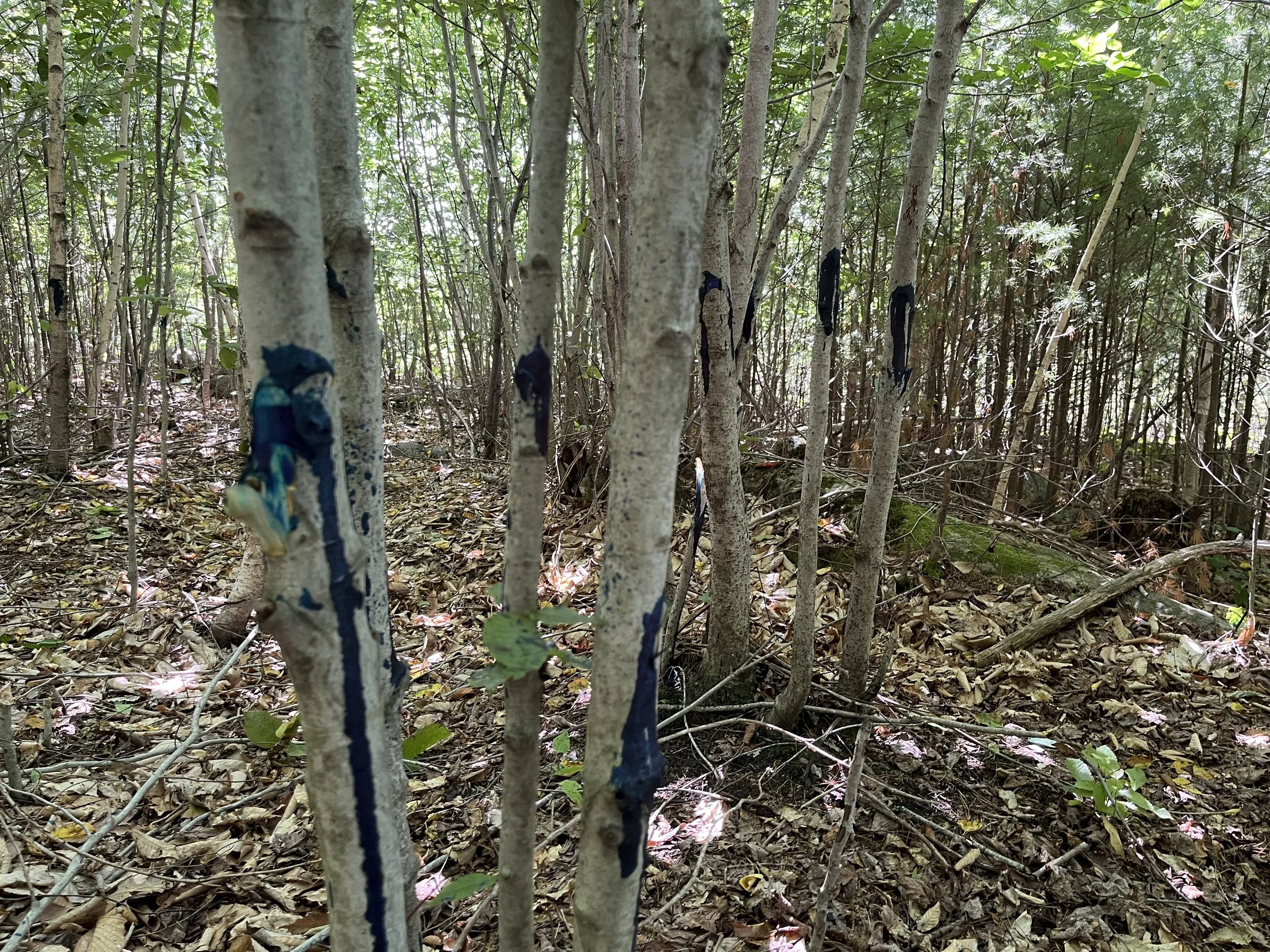
Hack and squirt to kill sapling trees and open up the bedding area canopy
I have identified 10 areas where I could improve the cover to make them more attractive for daytime deer bedding. In 2024 I improved one area and it took so much time and effort that I was looking for a different technique that would be easier. The goal is to open-up the canopy to let sunlight in, create “side cover” that will hide deer from nearby predators by cutting larger trees down to the ground or piling smaller trees off to the side, establishing bedding pockets on flat dry ground, and blowing the leaves away to expose the dirt for seed germination. If done correctly, the area will be transformed into thick vegetation with many trails and bedding pockets.
In 2024 I cut all the sapling trees by hand and piled them off to the side. I cut a couple larger trees down to the ground, but most of the side cover was created by the piles of trees. Working this way was very strenuous, and bending over to cut saplings flush to the ground was very tough on my back. I was looking for a way to open the canopy without stooping over so much.
Soybeans in August were stunted from the drought
So in 2025 I decided to try “hack and squirt” to kill the saplings in-place so as to not have to cut and stack them. I mixed up a spray bottle with a blend of herbicides (sorry, I forgot to take notes on the mixture, but there are plenty of recipes online) diesel fuel (to increase the herbicide penetration of the tree) and blue dye to help you see what you have treated. I used a hatchet to hack a wound into the tree, and sprayed the mixture into the wound. The resulting grove of blue splotches on trees look like an extraterrestrial crime scene.
This sounds easy, and it would have been ok if the weather had been cool. Unfortunately, you can’t do this in the early spring when the temperature is low enough to make wearing a protective jacket, mask, and rubber gloves comfortable - the sap is running strong in the early spring and will probably flush the herbicide out of the hack wound and negate your efforts. I had to do this in early July when it was hot and it was miserable work. I will go back in to see if it even worked, but I will be trying another technique in 2026.
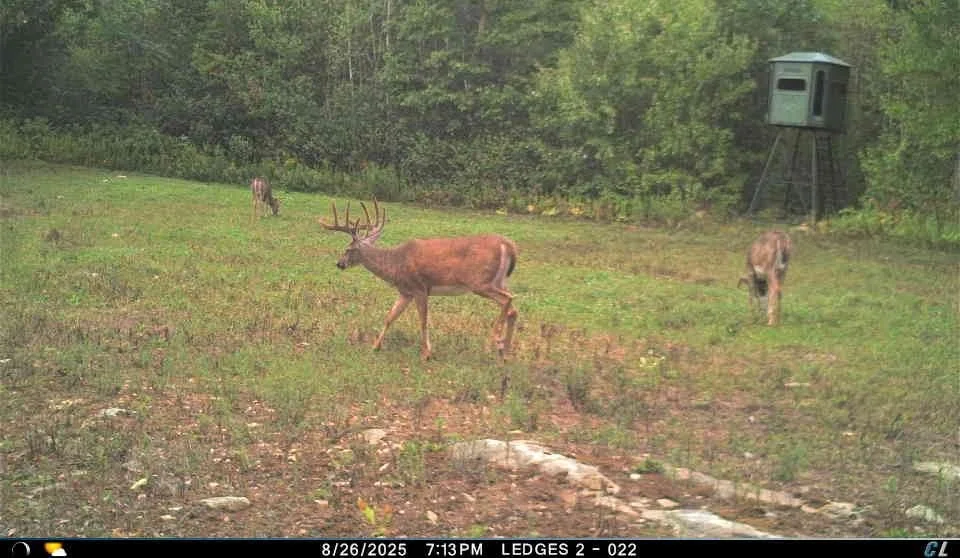
As hunting season approached the clover looked like hell
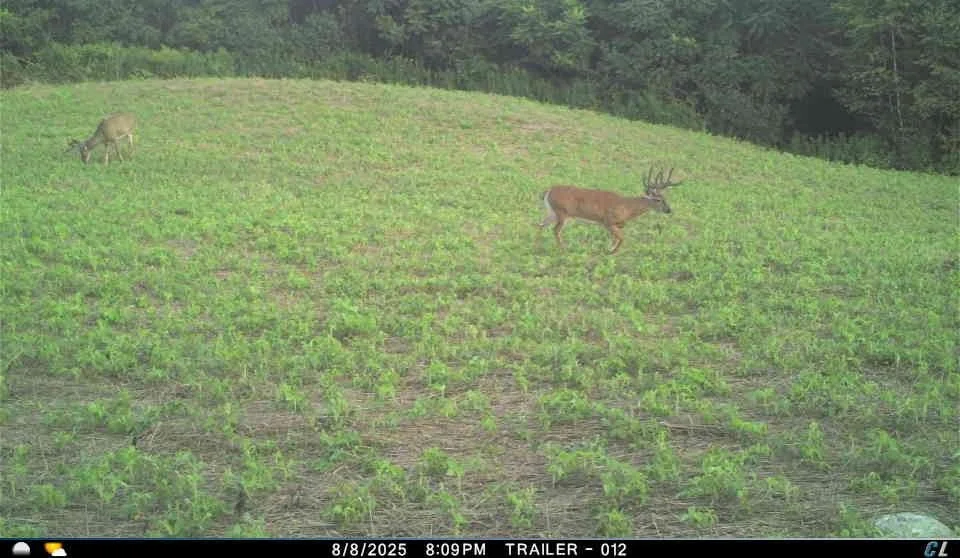
The drought started in the summer, after my soybean planting was up and growing. Up until then the clover plots were looking great, and the beans were getting going, but the spigot was turned off for the rest of the growing season. Soybeans always seem to do fairly well during a drought - I think it is because they have deep roots, their broad leaves shade the soil, and they collect dew from the moisture in the air. The beans were stunted, especially in the Central plot where the soil is mostly gravel and the plants were being browsed heavily by the deer. But the clover plots looked horrible. In thin soil areas it had burnt out, and where the soil was better it just couldn’t get enough moisture to grow. It was better on the edges of field in the shade. The weeds, of course, were doing just fine. I didn’t dare drive my tractor on the clover plots to mow the weeds down or spray the selective herbicides that kill weeds without affecting the clover. So I went into the September bow season with ratty food plots.
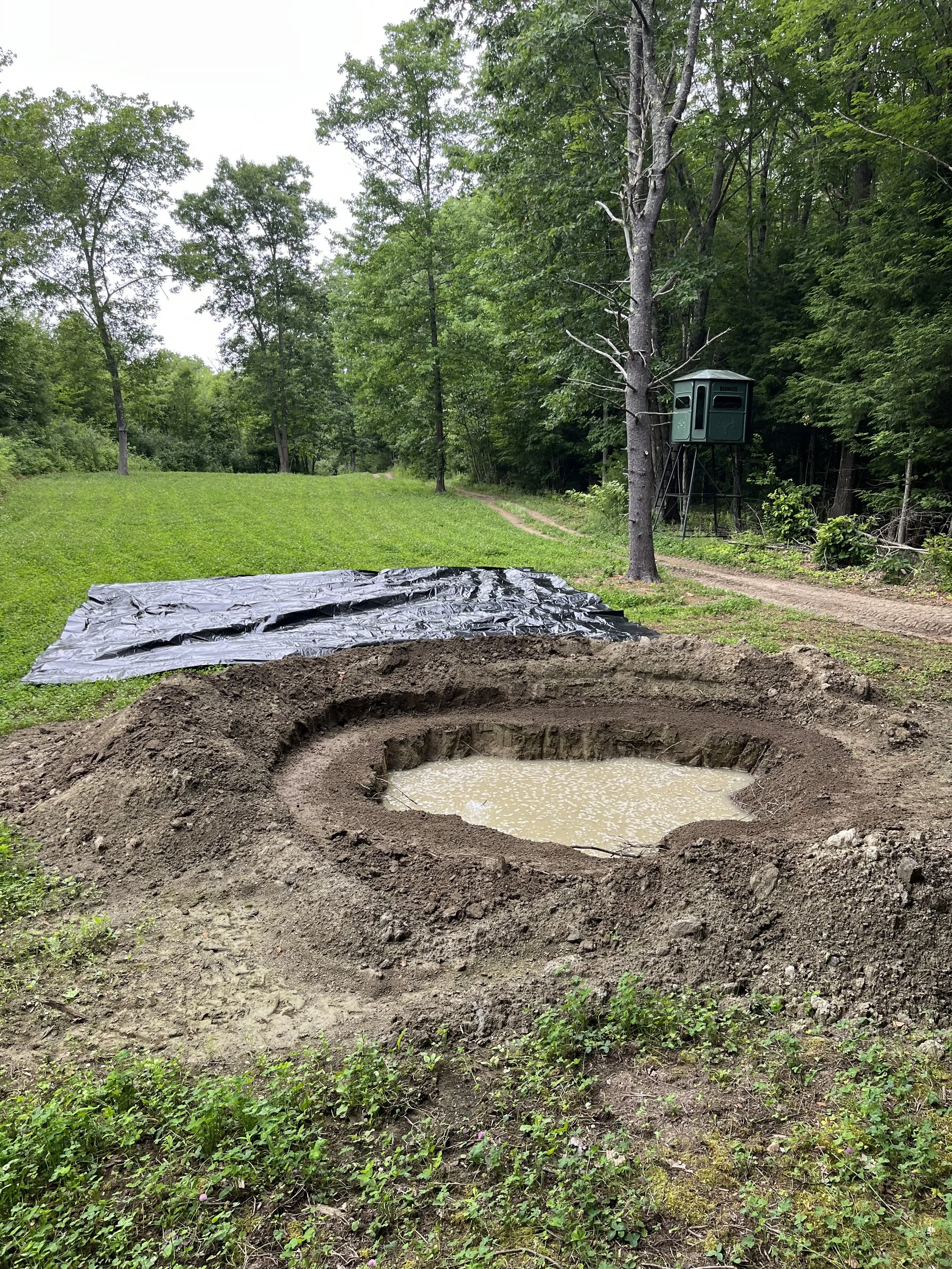
New pond at the Grove food plot
It was a hot summer and that kept me from some of my projects, but I still got a lot done. In the Grove food plot near the box blind was a spot that always filled with water when it rained and, because of the standing water, it didn’t grow clover. I dug a pond there with my backhoe, but I found that the soil was too porous to hold water when it was dry. I dug down 5 feet and the hole was empty for weeks so I had to put in a plastic liner - and it didn’t fill completely with water until late fall.
I cut or improved trails in several areas. From the Central plot to the north, Central to the east, and from the West Exit to the Pond plot. The new trail from Central to the east also allowed me to put up a new stand, the East Exit stand, to cover that trail during the rut, and I hinge-cut a barrier to the north of the stand to push deer to use the new trail. I cut an exit trail from the Water Tank stand out to the paved road, and then cut a trail from the South Fence stand to connect with the new Water Tank trail. These new exit trails now allow me to walk through the Homestead field in the middle of the day to access these two stands, and then use the trails to get out after dark without being seen by the deer in the Homestead field.
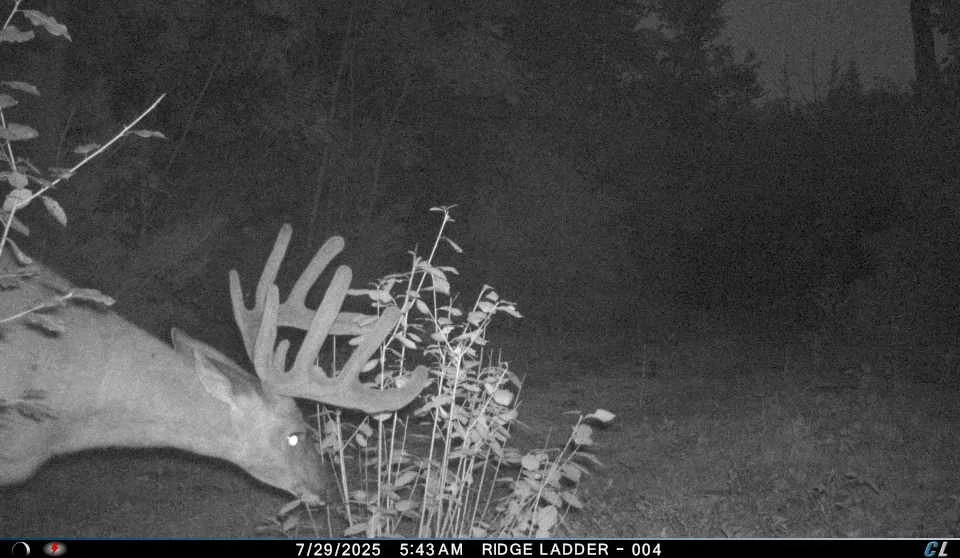
I’d been getting photos of Nancy on camera all summer long
I moved the Ridge Ladder stand from right on the property line to a tree 20 yards away. The previous location was very exposed as the hunter was sticking out in a lone tree with nothing nearby to break-up his outline. The new location has the ladder stand strapped to one trunk in a cluster of four trunks, so the hunter is hidden by the group of trees. I also moved the Creek stand so a hunter could better cover the nearby trails that I expect deer to follow. I am planning to remove the Creek stand in 2026 because I want that location to be more of a bedding area and sanctuary for deer - the stand is at the bottom of a steep gulley and there isn’t a good way to get in and out. I have only hunted the Creek stand once because on the way in you will probably blow-out any deer that are bedding in the area.
When the weather was very hot in the middle of summer I could still get things done with my tractor without dying from the heat. I had several loads of gravel trucked in as far as my dirt guy could get them, which was next to the Lightning plot. I took them from there with my tractor, bucketing and spreading them on the tractor road through the woods toward the Homestead field. I was able to improve the road to make it smoother and fill in the areas that usually get muddy.
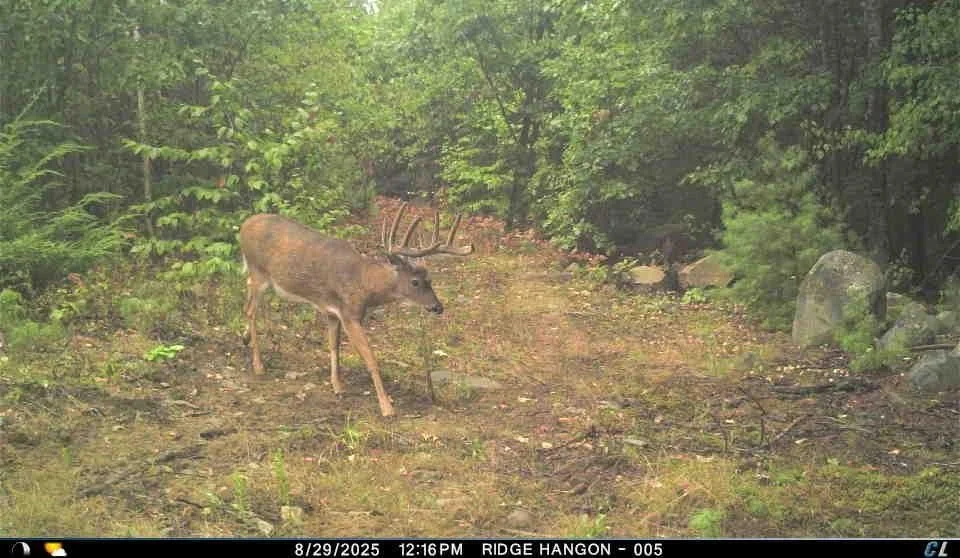
Nancy was a beautiful 10-point and at least 3 1/2 years old
The hunting season started September 6th and it was hot. Not wanting to alert the deer that they are now being hunted, I followed my usual strategy and started near the north property line at the Barn plot. I like to hunt the fringes of my land first, hopefully taking a doe for the freezer, and always keeping my eye out for a shooter buck. By hunting the property fringes I can get in and out without jumping deer or leaving scent in places that the deer don’t expect.
The Barn and Garden food plots border the barn on two sides and deer can come from any direction. Keeping the windows closed in the box blind next to the barn prevents deer from smelling me, but it is sweltering on a hot sunny day. A doe came within shooting range in the afternoon, but she had four fawns with her. Four! I had seen them all together on camera during the summer with no other does so I believe that they were all her offspring. I didn’t want to remove from the herd such a good producing doe, so I passed on her.
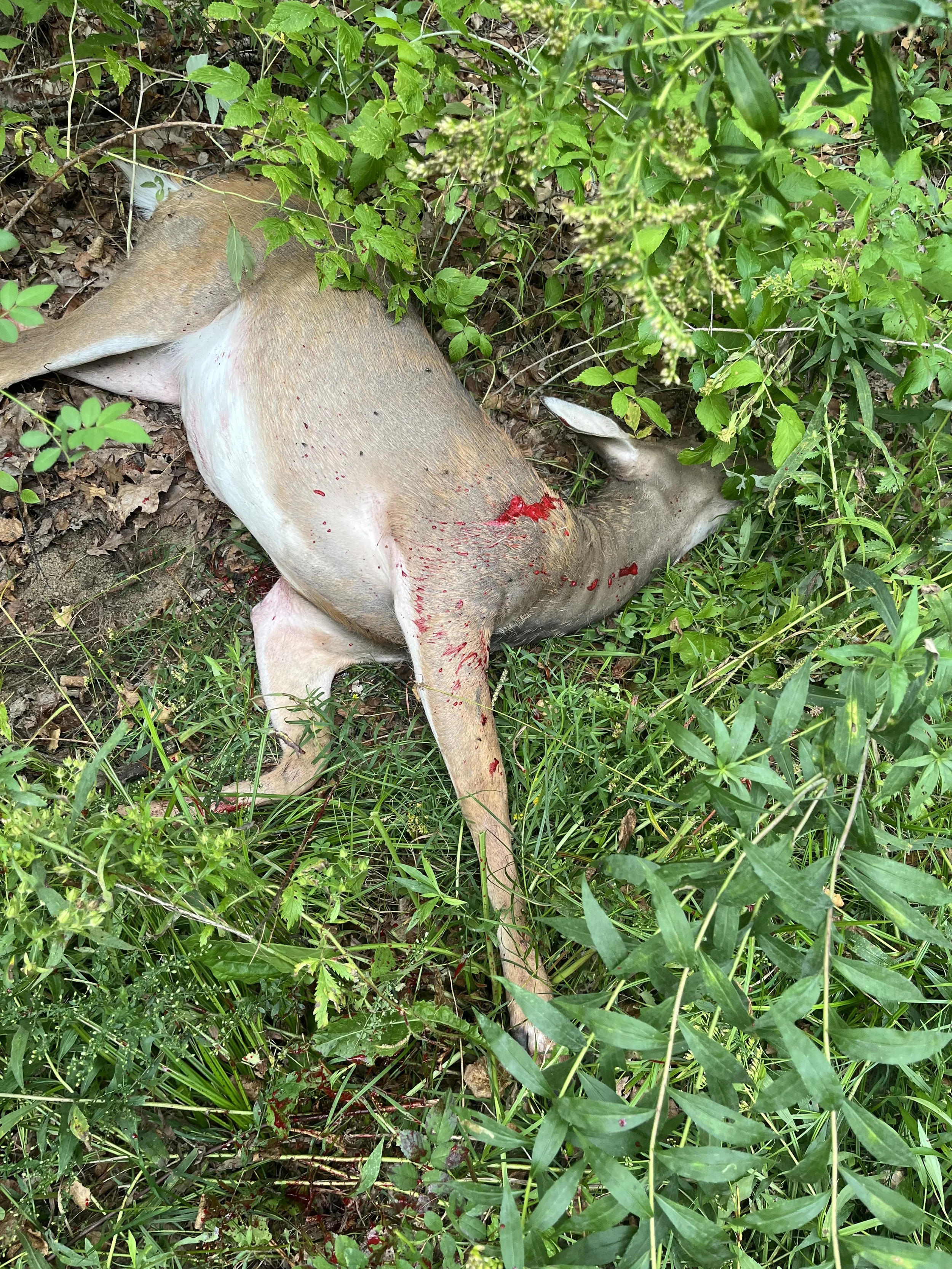
Early season doe for the freezer
I’d been seeing a really nice buck on camera all summer long. He was a 10-point that, judging from his body, was at least 3 1/2 years old and maybe 4 1/2. He had a great rack with long tines and, if I could take him, he would easily be the best buck that I have taken off the farm. Good friends Tom and Nancy asked during the summer if I had named him, and I told them I was calling him Big Ten. Nancy gave me an extra ration of grief for such an unimaginative name, so I changed his name to Nancy.
The temperature on September 13th was in the 70s and it was cloudy - I was hunting from the box blind at the Ledges food plot. The clover had been burnt-out by the summer drought, but there was still some patches of green forage and a spike buck came in to feed at 4:00 PM. I don’t shoot yearling bucks so I let him walk off to the east 20 minutes later.
Not long after the spike had walked off a good size doe came in from the east. The spike came back as well, following the doe. The doe was broadside at 20 yards when I shot her, and she ran off to the west. The spike stayed in the plot, staring and stomping as he tried to figure out what had happened - he was unnerved by her speedy exit and knew that something wasn’t right. But the spike wouldn’t leave. I finally shouted out the door to make it sound like someone was in back of the blind and that persuaded him to get out of there. The doe had piled up right on the tractor road 50 yards away. A perfect double-lung shot. She weighed 123 pounds - a nice addition to the freezer.
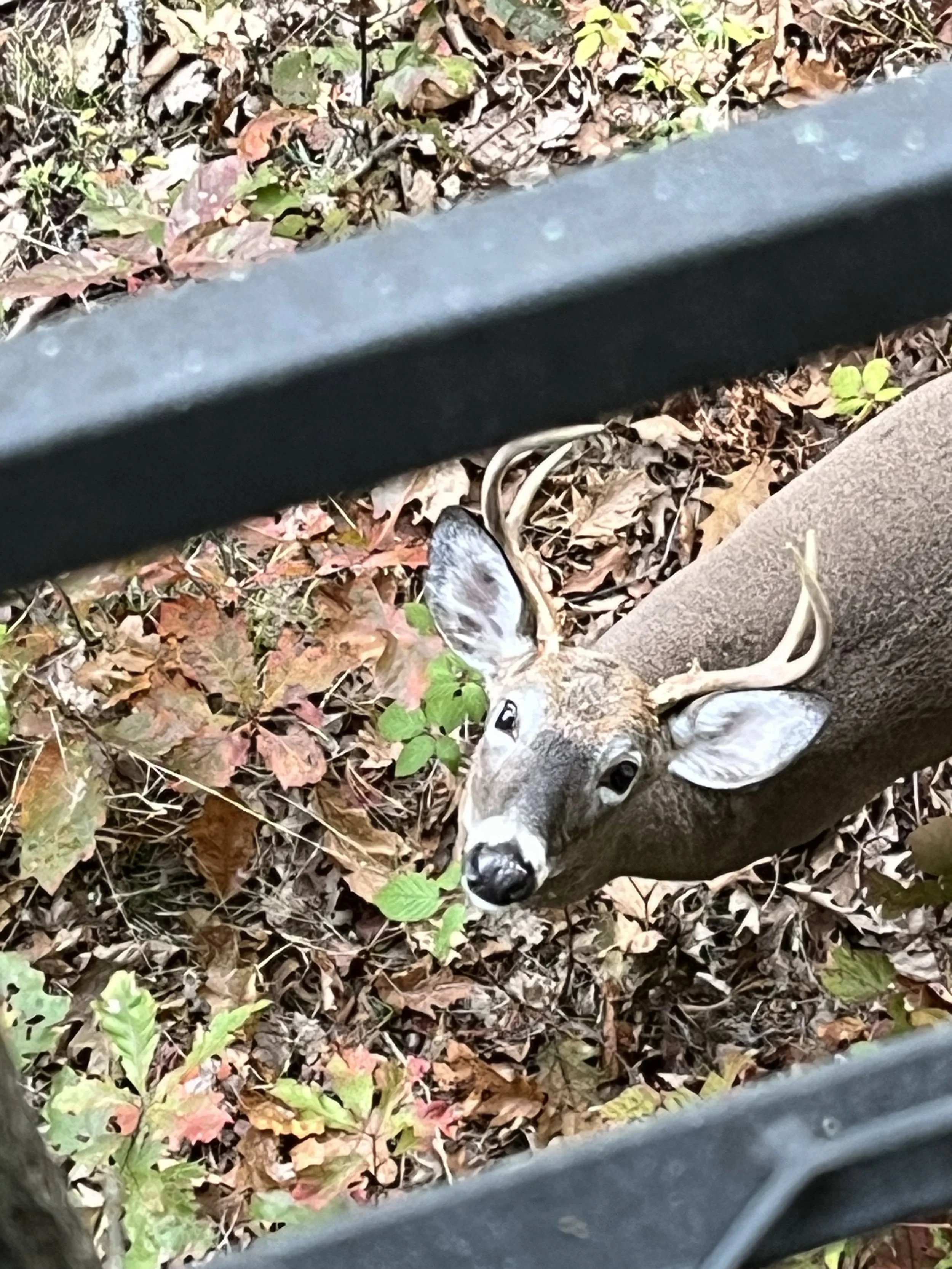
Nancy’s buddy checking me out
Over the next month I only hunted six times, continuing my strategy of making as little an impact on the deer movement as possible and choosing the best locations based on the wind. I tried a variety of blinds and stands covering all of my land. I saw deer half the time and had several opportunities to take another doe, but I felt like I had a good quantity of meat in the freezer. Also, if you shoot a deer you create a lot of commotion that may spook other nearby deer that have not yet come into view. I continued to get Nancy on my cameras - he was a true homebody. I really wanted to get a crack at him.
During August, September, and now into the middle of October I had been getting a steady stream of Nancy photos as he made an appearance on most of my cameras. I run 24 cell-linked cameras that are powered by solar panels so it was easy and unobtrusive to keep tabs on him. In August and early September he had most often been on the north half of the land. Late September into October he was frequenting the southern half.
Nancy would be caught on camera in the Central food plot, so I would hunt the Trailer blind. Then he would show up over by the South Fence stand so I would hunt the Water Tank. My priority was minimum impact, getting in and out without alerting the deer. I had good action half of the time, but I felt that another good acorn crop was tending to keep the deer in the woods during daylight, and out of my food plots.
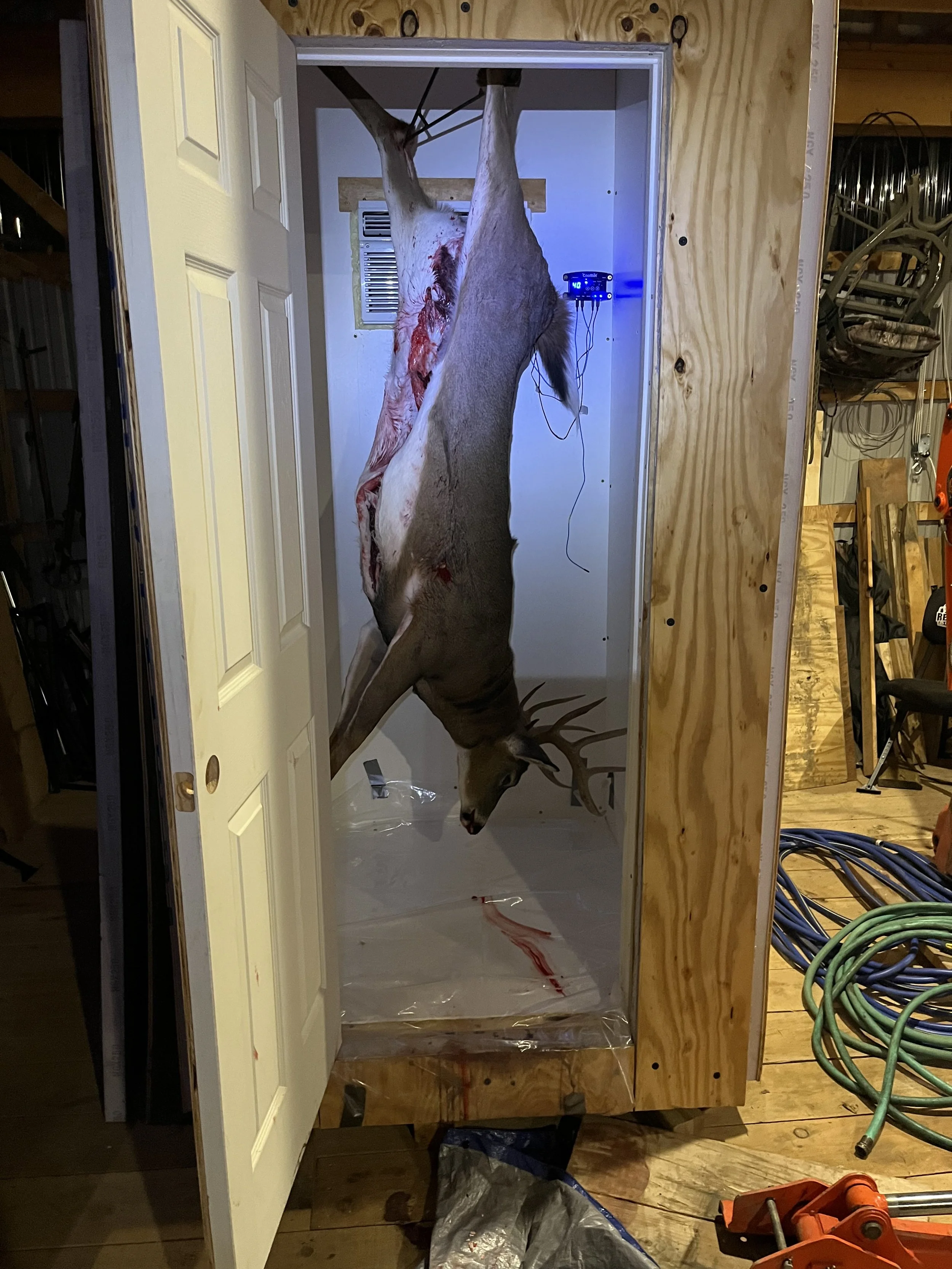
Nancy spent the night in the cooler
On October 15th I was hunting the West Exit stand and it was cool and partly cloudy. The wind was out of the NNW at about 10 MPH but it was gusting and swirling. I put up my Ozonics ozone generator because I thought there was a good chance that the deer would catch my scent. Nancy had daylighted here the day before, but then again he was on-camera way over at the Homestead field overnight so I didn’t have confidence that he was living on this side of the land.
Just before 5:00 a 2 1/2 year old five-point walked in from the southwest and fed for about 15 minutes before walking back the way he came. As he fed he ranged around the plot, and even looked up right at me in my stand, but seemed relaxed - it is amazing how camo keeps a deer from seeing you as long as you do not move. I took a bunch of photos and video - it was cool to spend that time watching him.
The five-point looked like he had crossed down wind of me on his way into and out of the plot but he didn’t catch my scent so maybe the Ozonics had done its job. An hour later he came back into the food plot and began eating again. After a few minutes I noticed that another deer had come in from the same direction. The Five-point had a buddy. A bigger deer. A buck. It was Nancy!
The big buck took his time getting into a position where I had a clear broadside shot. It was about 10 minutes that seemed like forever, my heart beating so loud I thought he must be able to hear it. He was just below me and so close. Finally he moved into the perfect position and I had a shot at about 15 yards. I looked over at the smaller buck to make sure he wasn’t looking, and when I drew my bow I remember double checking that the string was positioned correctly and everything was clear. I made a perfect double-lung shot and watched him shoot off to the east.
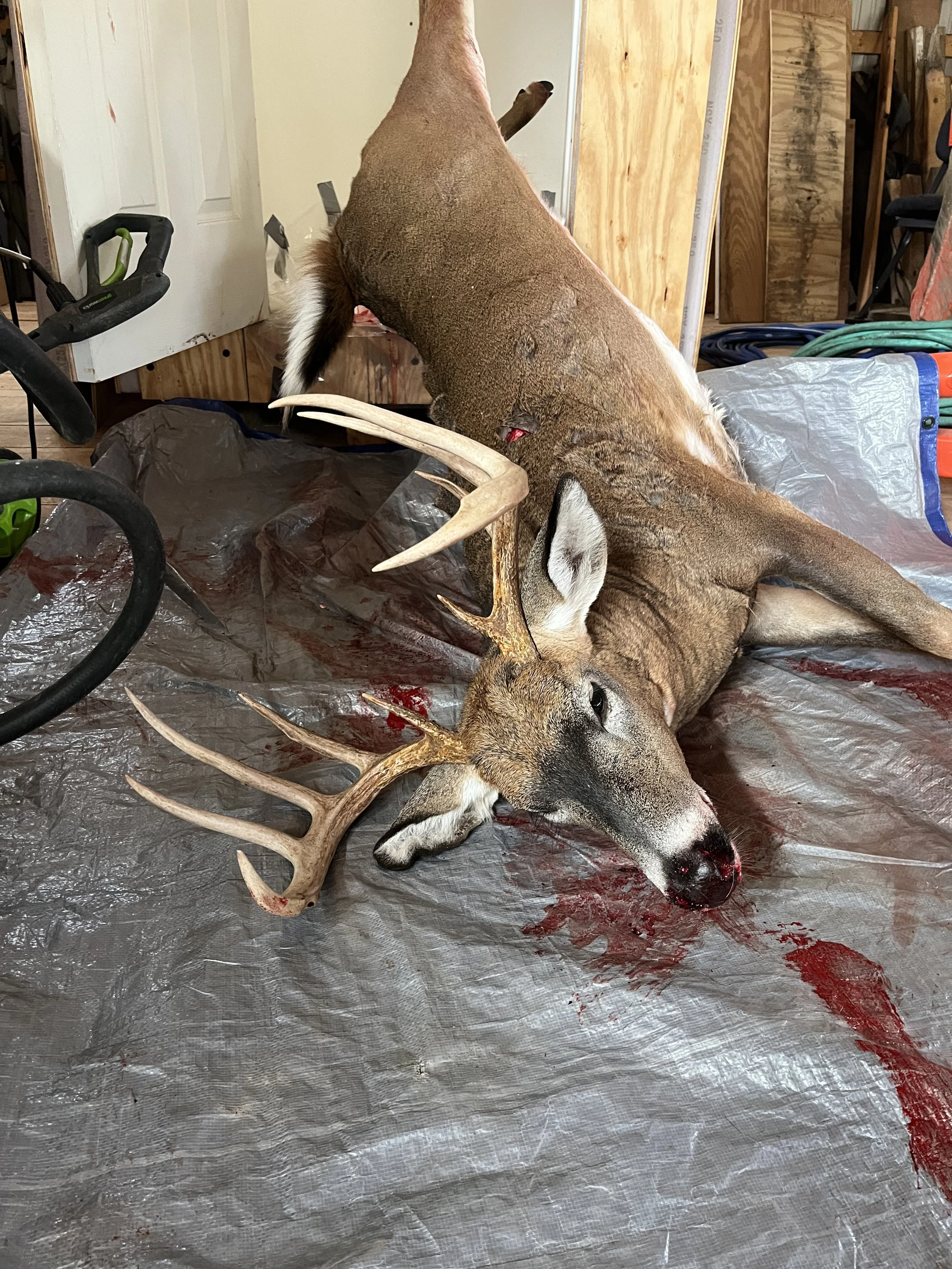
An awesome 178 pound 10-point with long tines
He ran about 50 yards straight away from me and I watched him stop. I couldn’t see clearly, but he seemed to stagger, maybe spin around, and then lurch to the left. I figured that he had gone down, so I packed-up and got down right away. I picked up my arrow and looked for blood on the ground. I knew where he had gone so I wasn’t too careful with the blood trail but, when I got over to the spot where I’d last seen him, the trail stopped. I looked off to the left where I thought he’d gone, but I couldn't find blood.
It was now getting dark, so I took off my pack and got out my headlamp. As I was doing this I swore I could smell him. Looking to the left with the light I still couldn’t see blood. I turned to do a 360 degree sweep, and there he was. Two steps behind me. At the last moment, when he was losing consciousness, he had lurched to the right, not the left.
I went back to the barn to get the tractor, and came back to recover him. What a joy to have the hunt go according to plan! And to make a perfect shot - I had also taken a buck and a doe the year before and neither shot was good. Nancy weighed 178 pounds and will have a place of honor on my wall. I cooked steaks from both the doe and the buck and found that the doe had a better consistency - the flavor was fine with both, a testament to cooling them down right away after harvest. A good size doe meets our meat needs for the year, so most of the buck went to the Augusta Food Bank.
I hunted on this land just three more days in 2025, and all three were in late October with a friend - no more deer were taken. I monitored my cameras during the balance of the season but didn’t see a buck worth hunting. I had one buck that was probably 3 1/2 years old, but his rack was crappy. I had some great buck sign on my New Sharon tree farm - with 722 acres and a new rifle, I spent the rest of the 2025 season hunting there.
To keep reading about my land management project, Click Here To Go Forward To 2026
To go back to the previous page, Click Here To Go Back To 2024